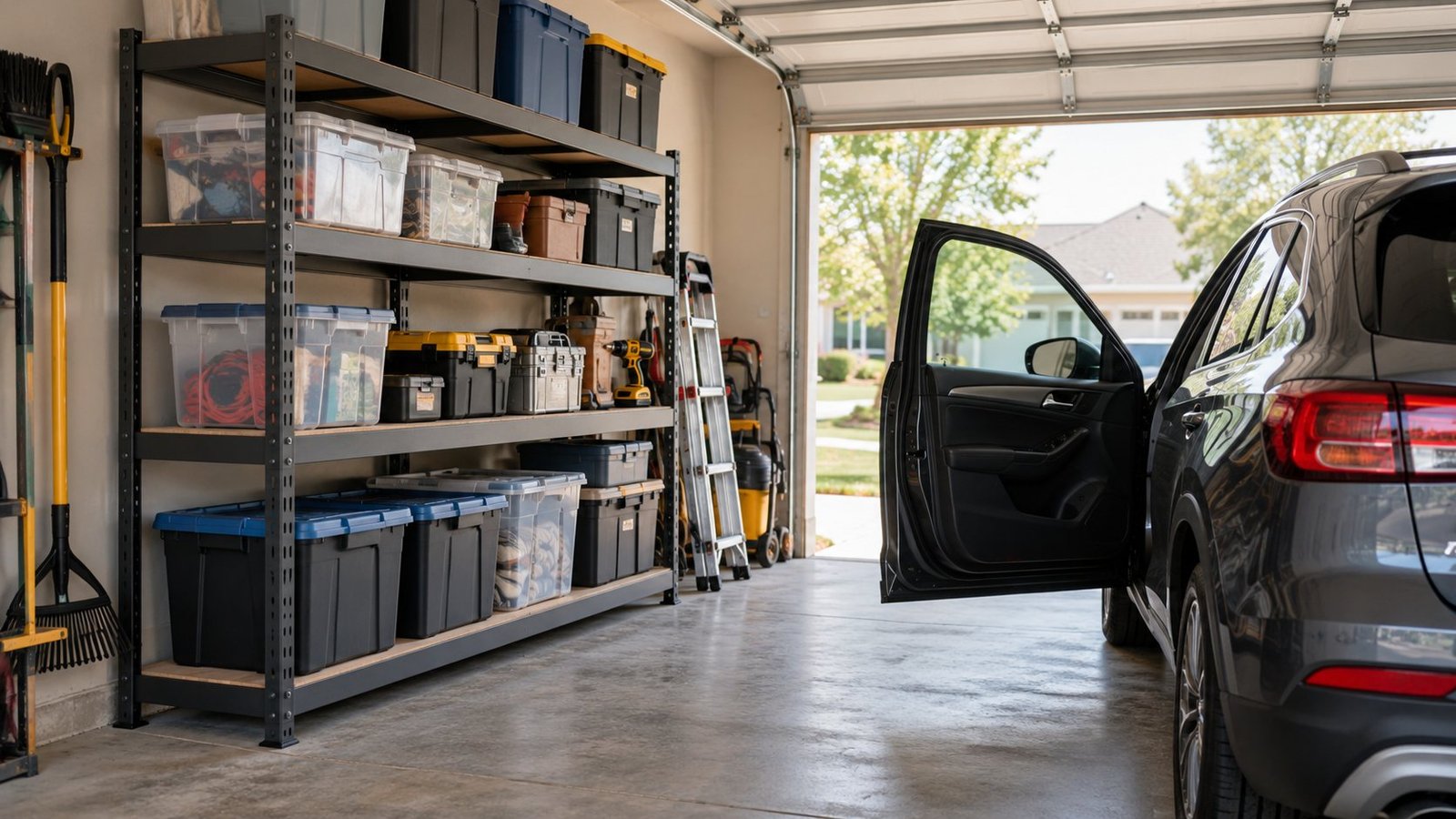
Editorial note. This guide contains no ranked products or merchant links. Generated photographs illustrate planning concepts and are not evidence of a product’s construction, capacity, fit, or performance.
Short answer
The best garage shelving is the unit that passes six checks at the same time: it fits the occupied room, fits the stored items and bins, carries the load in the exact installed configuration, suits the garage environment, keeps items safely accessible, and can be assembled and stabilized according to its instructions.
Start with the storage zone, not with a sale price or a capacity headline. If the floor is still crowded, use Get Things Off the Floor first. If the garage does not yet have clear activity zones, use the Garage Zone Map before measuring for a shelf.
1. Room fit
Width, depth, height, vehicle clearance, doors, tracks, outlets, utilities, baseboards, curbs, and floor slope.
Measure with the garage in normal use.
2. Item fit
Full bin dimensions, lid and handle clearance, shelf opening, upright spacing, and space to lift the item out.
Measure the object, not only its label.
3. Load fit
Per-shelf limit, total-unit limit, even distribution, point loads, and any change caused by casters or configuration.
Use the lowest applicable limit.
4. Environment fit
Moisture, road spray, dirt, cleaning method, temperature exposure, and whether the manufacturer permits the location.
Material alone is not a warranty.
5. Access fit
Reach, visibility, frequency of use, lifting path, and whether heavy items can stay low.
Capacity is not the same as safe access.
6. Installation fit
Assembly space, required tools and helpers, wall or floor support, supplied hardware, leveling, and anchoring.
Read the manual before ordering.
Measure the garage while it is occupied
An empty wall can make a shelf look shallower than it will feel beside a parked vehicle. Park the actual vehicle, open the nearest door to the position used every day, and trace the remaining safe footprint. Check the hatch, trunk, mirrors, passenger path, house entry, garage-door travel, and anything carried past the shelf.
Record usable wall width after baseboards, curbs, steps, pipes, outlets, panels, and equipment access are excluded. Measure height to the lowest obstruction, not only to the ceiling. If the floor slopes or has a curb, confirm that the feet or levelers can sit where planned and that the assembled frame can stand plumb.
| Measurement | What to record | Why it changes the choice |
|---|---|---|
| Maximum footprint | Usable width and maximum safe depth | Rules out units that enter the vehicle or walking envelope |
| Usable height | Floor to lowest track, opener, pipe, light, or other obstruction | Prevents an assembly or top-shelf conflict |
| Wall condition | Stud or masonry locations, finishes, utilities, baseboard, and curb | Determines whether a wall-mounted system or anchor method is possible |
| Floor condition | Slope, cracks, drains, moisture, and cleaning path | Affects leveling, stability, feet, material, and maintenance |
| Access path | Vehicle door, hatch, person, bin, and ladder movement | A shelf can fit the wall and still block normal use |
No universal depth: an 18-inch shelf may protect parking but fail to support a deep tote. A 24-inch shelf may fit the tote but take too much from a narrow parking aisle. The correct depth is the smaller of what the room allows and what the stored item requires.
Compare the shelving formats
Format decides where the load goes and how easily the garage can change. Compare the installed system, not only the deck material.
| Format | Useful when | Main tradeoff | Verify before buying |
|---|---|---|---|
| Freestanding boltless rack | You need broad shelves, adjustable levels, and a simple storage wall | Uses floor depth and may require anchoring or leveling | Opening between uprights, deck support, per-shelf rating, total rating, anchor instructions |
| Wire shelving on posts | You want adjustable shelf heights, visibility, and an optional mobile configuration | Small items need bins or liners; casters may change the rating | Stationary and caster ratings, wheel locks, sleeve seating, smooth rolling surface |
| Resin shelving | You want a lighter unit with a washable nonmetal frame for suitable household loads | Shelf spacing and configuration may be less flexible; ratings vary widely | Per-shelf limit, wall attachment, indoor or outdoor restrictions, replacement parts |
| Wall-mounted shelf | You need a clear floor or storage above a fixed lower zone | Capacity depends on the wall, fasteners, support layout, and exact installation | Permitted wall types, stud or masonry spacing, hardware, shelf depth, cable or bracket path |
| Custom built-in shelf | The room has an unusual footprint and the builder can design the load path | No retail capacity label automatically exists | Material span, fasteners, structure, moisture, load design, and qualified help when needed |
Do not use a general format description as a capacity claim. Two steel racks of the same size can have different decks, beams, connectors, feet, anchors, and tested configurations.
Read the load rating in context
A capacity number is useful only when you know what it describes. Look for a per-shelf rating and a total-unit rating. Do not divide the total by the number of shelves unless the manufacturer explicitly says to do that. Check whether the rating assumes a level floor, stationary feet, wall attachment, evenly distributed weight, a particular shelf spacing, or another required configuration.
Evenly distributed means the published load is spread across the supported shelf area. A dense object in one small spot can load the deck and beam differently from several bins spread across the shelf. Keep heavy items low when the manual instructs it, and never exceed either the per-shelf or total-unit limit.
| Current manual example | What it demonstrates |
|---|---|
| Husky wire shelving manual | One manual lists a 300 lb per-shelf limit, calls for even distribution, heavy loads on the bottom, and placement on a level surface. |
| TRINITY TBFZ-0945 wire rack manual | For one current model, the stated per-shelf and total ratings are much lower on casters than on stationary levelers. Configuration changes the usable rating. |
| NewAge wall shelf materials | The published wall-shelf rating is tied to specified support and installation conditions. The shelf number cannot be separated from the wall and fasteners. |
| DEWALT rack support page | The current rack includes shelf-locking parts and a wall anchor kit. Stability hardware is part of the intended system, not an optional styling detail. |
About “heavy duty”: treat this phrase as marketing until the manual identifies a numeric limit, the exact configuration, and the installation requirements. A high number does not compensate for the wrong dimensions or an unsupported wall.
Choose the shelf surface and material
Choose for the stored item, the garage conditions, and the maintenance you will actually perform. The frame and the shelf deck may use different materials, so inspect both.
Steel wire deck
Lets dirt and light pass through and makes it easy to see leaks or debris. Small feet, loose hardware, and soft bags may need a compatible liner or bin.
Verify grid spacing, clips, corrosion protection, and liner rules.
Solid steel deck
Supports small items on a continuous surface and is easy to wipe. Spills and moisture stay on the deck until removed.
Verify coating, seams, drainage, and the allowed cleaning method.
Engineered-wood deck
Creates a flat surface inside many boltless racks. Moisture exposure, edge condition, and deck support matter.
Verify the manufacturer’s location and care limits.
Resin shelf
Uses a nonmetal shelf surface and can suit washable household storage. It is not automatically outdoor-rated or suitable for every chemical or temperature.
Verify rating, environment, wall attachment, and cleaning guidance.
If the garage stays damp, receives road spray, or sometimes takes on water, solve the moisture source before assuming a material will protect the contents. Keep stored items off a wet floor only when the shelf and contents are suitable for that environment.
Test bin fit and everyday access
A shelf specification usually gives overall width, depth, and height. Those numbers do not guarantee that a tote fits between the uprights, passes under the beam, or can be lifted out without hitting the shelf above. Measure the full bin at its widest and tallest points, including lid, handles, latches, wheels, and any outward taper.
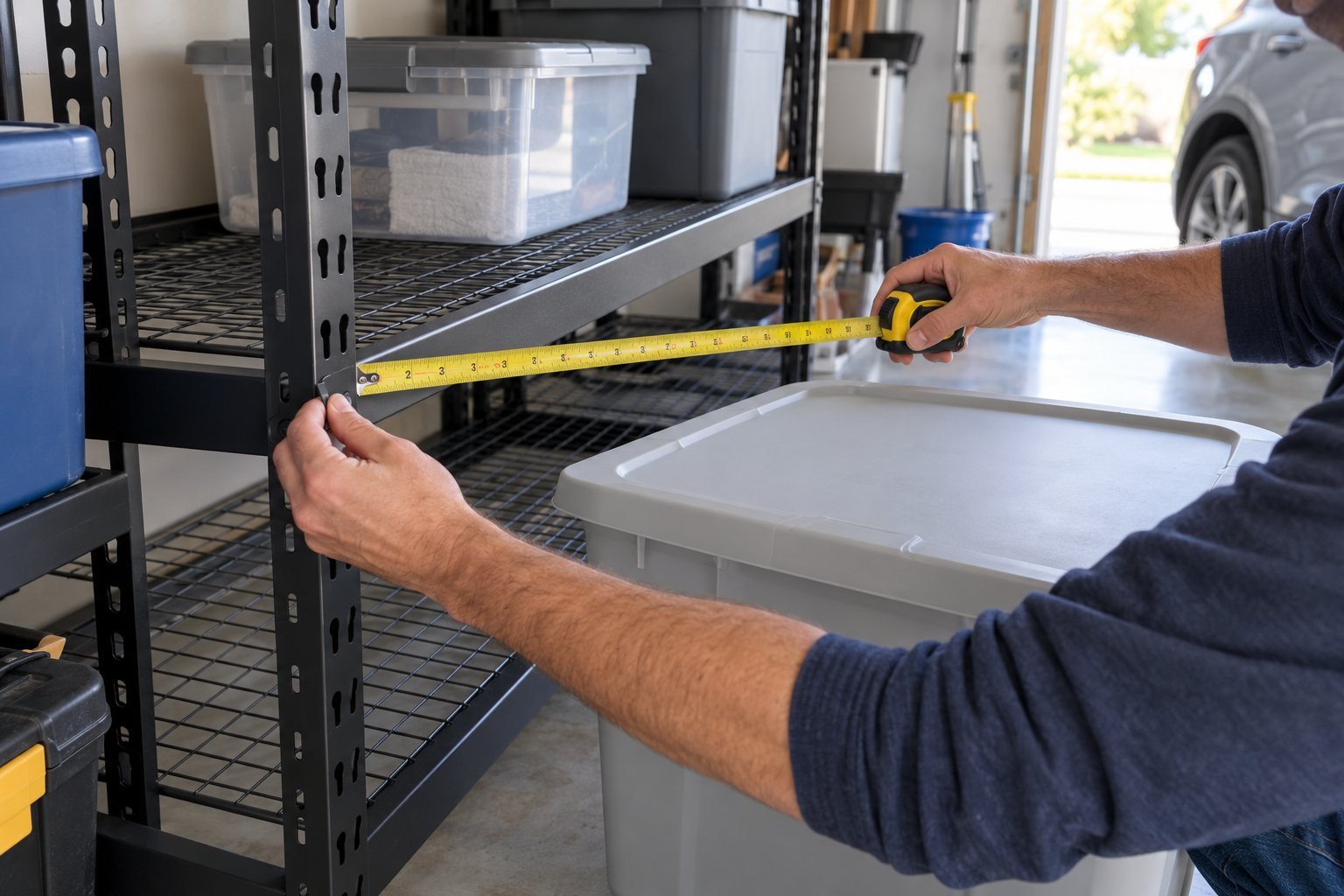
| Fit check | Measurement | Common miss |
|---|---|---|
| Shelf depth | Usable front-to-back support area | Comparing the bin base with the rack’s overall depth |
| Clear width | Space between uprights and connectors | Using only the advertised outside width |
| Clear height | Deck to the lowest beam or shelf obstruction | Forgetting the lid and hand space |
| Removal path | Space to tilt, grip, slide, and carry the bin | Fitting the bin with no room to use it |
| Loaded weight | Container plus everything inside | Weighing an empty tote or guessing from volume |
Place daily and weekly items between comfortable knee and shoulder reach when their size and weight allow. Reserve lower shelves for heavy or awkward loads. Use upper shelves only for suitable items that can be retrieved without an unsafe reach or unstable climbing setup.
Plan assembly, leveling, and stability
Read the complete installation manual before ordering. Confirm the box can reach the garage, the unit can be assembled in the available space, and the finished frame can be raised into position without hitting the ceiling or tracks. Check whether the instructions require two people, specific tools, wall attachment, levelers, shelf locks, cross braces, or periodic fastener checks.
For wall-mounted shelving, identify the actual wall construction and permitted support locations. Use only the fastener type, size, spacing, and supporting material allowed by the manufacturer. Drywall finish is not proof of a suitable load path. If the wall, utilities, masonry, or structural support is uncertain, stop and use qualified help.
For freestanding shelving, follow the supplied stability and anchoring instructions. A shelf can be called freestanding and still include or require a wall anchor. The U.S. Consumer Product Safety Commission recommends anchoring furniture such as shelves and bookcases to reduce tip-over risk, especially where children may access the space.
Before assembly
Confirm parts, damage, manual version, tools, helpers, and final orientation.
Do not improvise missing structural parts.
Before loading
Level the unit, seat and lock components, attach required anchors, and check every fastener.
Load only after the intended configuration is complete.
While loading
Spread the load, keep heavy items low, protect the clear path, and retain labels and manuals.
Do not rely on visual appearance to estimate capacity.
During ownership
Inspect for movement, loose hardware, corrosion, deck damage, water exposure, and changed use.
Unload and correct a problem before it grows.
The buying checklist
A candidate shelf is ready for comparison only when every line below can be answered from measurements or current manufacturer information.
| Decision | Record before purchase |
|---|---|
| Zone | Wall location, maximum width, depth, height, and protected clearances |
| Contents | Item groups, heaviest loaded container, largest bin, use frequency, and access needs |
| Capacity | Per-shelf and total limits, even-load condition, stationary or caster configuration |
| Construction | Frame, deck, connectors, shelf adjustment, replacement parts, and permitted environment |
| Installation | Wall or floor support, anchor method, tools, helpers, leveling, and assembly footprint |
| Ownership | Cleaning, inspections, warranty, manual availability, and future bin compatibility |
Red flags that should pause the purchase
- Only a total capacity is shown and the per-shelf limit cannot be confirmed.
- The listing says heavy duty but no manual or configuration-specific rating is available.
- The advertised outside dimensions are available but the clear shelf opening is unknown.
- The rating changes with casters, anchors, or shelf layout and the intended configuration is not documented.
- The required wall type, fasteners, or support locations do not match the garage.
- The shelf fits the wall but enters the vehicle, door, walking, utility, or garage-door envelope.
- Replacement decks, clips, connectors, or instructions cannot be identified.
Common questions
Is 18-inch or 24-inch garage shelving better?
Neither depth is universally better. Use the deepest shelf that supports the intended items while protecting vehicle doors, walking paths, utilities, and normal access. Measure the bin and the occupied garage before choosing.
Is metal or plastic shelving better for a garage?
Choose by the complete system, not material alone. Compare the current per-shelf rating, frame and deck construction, environmental limits, cleaning guidance, stability hardware, and bin fit. Steel and resin units both range from light-duty to higher-capacity designs.
How much weight should a garage shelf hold?
Enough for the measured contents with room inside the manufacturer’s published per-shelf and total-unit limits. There is no useful universal number because ratings depend on the design and configuration. Weigh loaded bins and use the lowest applicable limit.
Should garage shelving be anchored to the wall?
Follow the exact product instructions and the conditions in the garage. Many freestanding units include or require stability hardware, and wall-mounted shelves depend on permitted support and fasteners. Do not assume freestanding means tip-resistant.
Can I put a garage shelf on casters?
Only when the model supports the intended caster configuration. A current manufacturer manual can list a substantially lower rating on casters than on stationary feet. Verify per-shelf and total ratings, caster installation, locks, and the surface used for rolling.
Should I buy bins or shelves first?
Plan them as one system. If you already own bins, measure their full outside dimensions and loaded weight before choosing the shelf. If starting from zero, choose a repeatable shelf opening and bin family together rather than buying either one in isolation.
Sources reviewed
GarageClever reviewed current U.S. search results to confirm comparison intent, then used retailer guidance and current manufacturer materials to define claim boundaries. Exact specifications remain product-specific.
- The Home Depot: Garage Storage Buying Guide
- Husky/Home Depot: Wire Shelving Use and Care Manual
- TRINITY: TBFZ-0945 Wire Shelving Rack Owner’s Manual
- NewAge Products: Garage Product Support and Installation Guides
- NewAge Products: Pro Series Wall-Mounted Steel Shelves
- DEWALT: 4 ft. Steel Wire Storage Rack
- Keter: Fused Heavy Duty Shelf Instructions
- U.S. CPSC: Childproofing Your Home