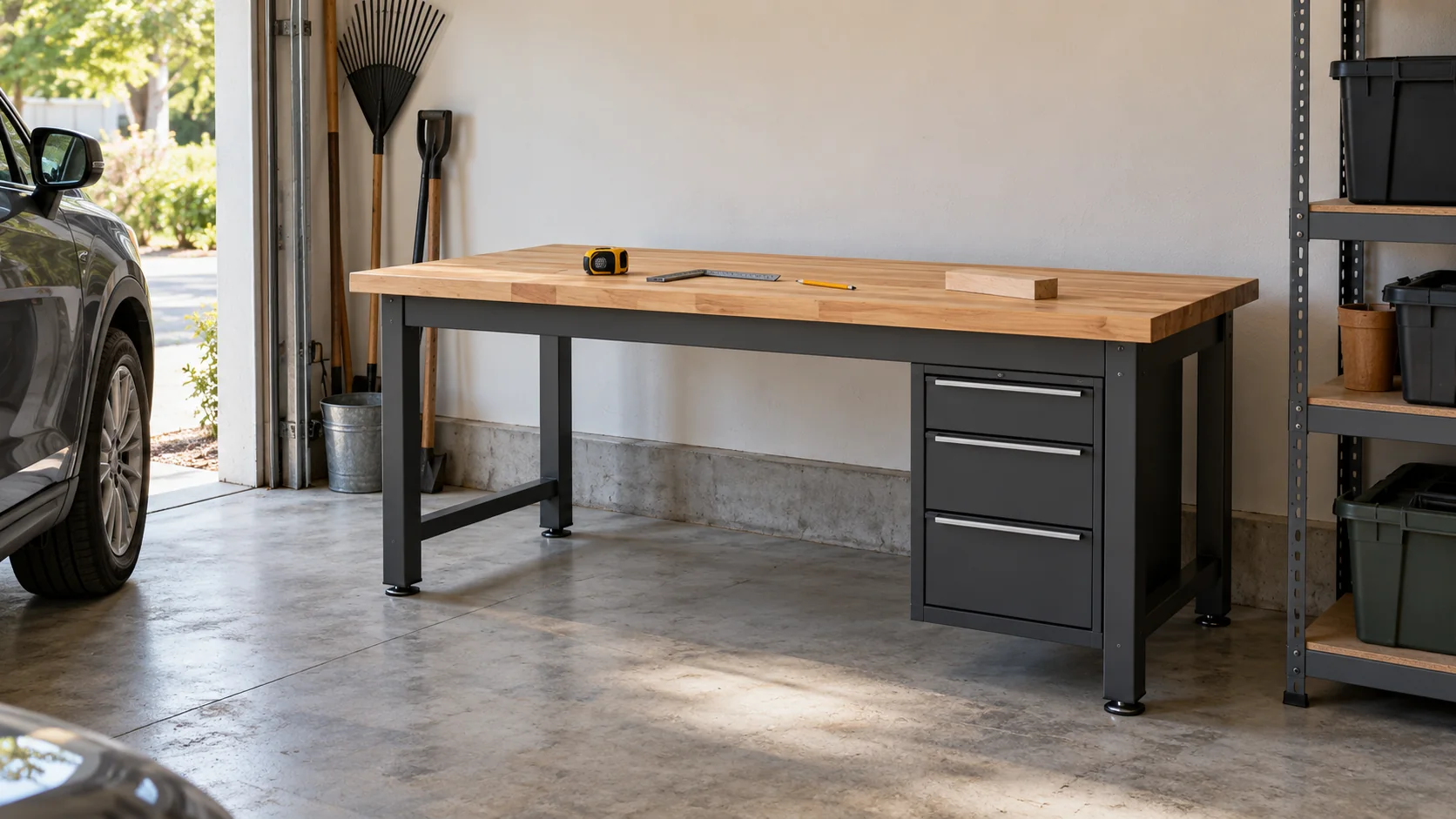
Choose a garage workbench around the jobs you actually do. Measure the space with your car parked, then compare working height, storage, and the exact model’s documented load and tool-attachment limits.
This is research-based buying guidance, not a report of physical testing or a product ranking. See our methodology for the editorial approach.
Try your existing workspace first
Clear the work area.
Clear and reorganize your current work area: move bulky supplies to separate storage and leave room for the tools, materials, and jobs you regularly handle.
Try the footprint.
Mock up the working footprint with tape or cardboard while the car is parked, then compare reach, working position, and access around the project. The result should be a usable workspace plan, not a shopping list.
Keep it or define the gap.
If your present workspace meets those jobs, reach needs, and parking clearance, keep using it; if it does not, use the measurements and checks below to define what needs to change before comparing bench formats.
Mock up the space before ordering
Mark the proposed footprint with tape or cardboard while the car is parked normally. Include handles, projecting hardware, and the space needed to open drawers. Try the car doors, walk to the house door, and check garage-door movement without placing obstacles in its path.
Now picture the workpiece, not just the bench. Can you bring a long board inside, turn it, and work around it? Is there room to stand at the end? Repeat the check with the bench in its stored position if it rolls or folds. Sketch a delivery route through doorways too. Our garage storage zones guide can help you separate working space from stored items.
Choose height for the person and task
CCOHS advises matching working height to the person’s body size and particular task, rather than choosing one universal bench height.Guide [3] It also recommends placing tools within easy reach without twisting or bending and allowing room to change position.Guide [3]
Use a mock surface to compare positions for your intended work, including the height of the workpiece. For seated tasks, check knee space beneath the top and whether a drawer bank, shelf, or crossbar occupies it. CCOHS recommends a sitting option where possible, with the seat height suited to the work.Guide [3] If several people will use the bench, compare their needs with the documented adjustment range.
Keep the work surface available for the project
Compare the clear working area after your usual equipment is in place. A bench with plenty of advertised surface can still leave little room once a tool and parts trays occupy it. Ask whether the edge shape and underside leave room for the clamps you intend to use.
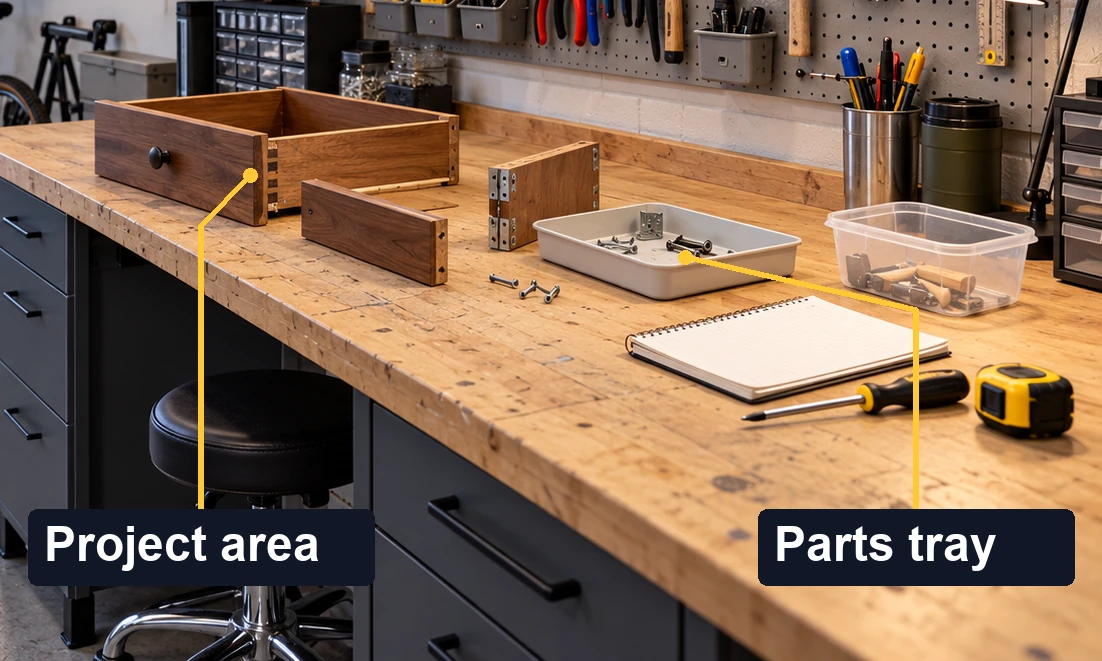
Choose drawers around what you need to retrieve during a job, then check their internal dimensions and ratings. Keep bulky supplies in a separate location if that preserves useful workspace. The garage shelving buying guide covers that separate storage decision.
Match the bench to your work
List your regular jobs before comparing benches: small repairs, seated hobby work, assembling bulky projects, or work involving a vise. Include the tools and materials that need to share the surface.
- Consider a fixed-height bench when one person does similar work in a dedicated spot. Check the actual height and the manufacturer’s permitted uses; a stationary design alone does not establish suitability for forceful work.
- Compare adjustable benches when people share the garage or tasks call for different working positions. Check the range, adjustment procedure, and any unloading requirements. Do not assume you can change the height with a project still on top.
- A rolling bench is worth considering when the work area changes between projects. Read the movement and working-position rules, rather than treating wheels and brakes as proof that it suits every task.
- Look at folding benches when parking takes priority and you can put the workspace away. Check both folded and open dimensions, the locking procedure, and restrictions on tools or work methods.
Illustrative examples, not tested recommendations: a household sharing small repair jobs might compare adjustable models; a hobbyist who must reclaim a parking bay might compare folding models. Someone planning regular vise work should first screen models for documented compatibility, not choose by bench type alone.
Check the specific worktop and finish
Treat hardwood, coated metal, and composite tops as categories to investigate, not durability rankings. For each model, ask which cleaners the manufacturer permits, what care the finish needs, and whether your planned chemicals or work methods are allowed.
Check whether the top is replaceable and whether the supplier identifies a compatible replacement. Ask if resurfacing, drilling, or adding a protective cover affects the finish, attachment system, or warranty. Include the frame finish in your review: look for documented care and repair guidance rather than assuming a material name predicts service life.
Read the load rating with its conditions
The indexed manufacturer description for Gladiator’s 8-foot adjustable-height hardwood workbench states a maximum distributed capacity of 3,000 pounds.Guide [4] That is a model-specific example of a qualified rating, not a recommendation or a general workbench limit.
Do not interpret a distributed rating as clearance for concentrated loads, hammering, or other impact or dynamic forces. Ask what the exact model’s documentation permits. Request separate ratings for the whole bench, worktop, shelves, and individual drawers where applicable. Do not treat the bench’s headline capacity as a drawer rating, or add component ratings together unless the manufacturer explicitly defines the combined limit.
Confirm vise and tool compatibility
Before planning a vise or mounted tool, ask whether the manufacturer permits that attachment on the exact bench and top. Request the applicable manual or approved attachment documentation. Confirm mounting-area requirements, underside access, restrictions on modifying the top, and whether the intended work is covered. These are compatibility questions, not mounting instructions. Leave a candidate off your shortlist if the answers depend on assumptions about its capacity figure.
Review movement, leveling, and total cost
For a rolling model, check which casters have brakes, what each brake controls, and the manual’s rules for moving and working at the bench. Ask whether it must be unloaded before movement. Check model-specific leveling provisions and floor requirements; brakes or leveling feet are not a universal promise of stability.
Compare the total delivered cost, including shipping, any delivery-service upgrade, assembly, required accessories, and replacement parts. Confirm where the carrier leaves the shipment and whether you need help handling it. Ask about damaged-delivery reporting, returns, and warranty exclusions before ordering.
A long adjustable-height workbench example
The Gladiator 8-foot Adjustable Height Hardwood Workbench, GAWB08HWEG, has a solid hardwood top and welded-steel legs. Gladiator lists a 96-inch width, 25-inch depth, 27.5–40.8-inch height range, and a 3,000-pound maximum distributed-weight capacity. Assembly is required.Gladiator GAWB08HWEG specifications
Compare it for projects that need a long stationary surface, not simply because the width fits an empty wall. Its distributed-load rating does not establish a concentrated-load limit, vise compatibility, or suitability for impact work.
- Check the delivery route and assembled footprint, then reserve standing room beyond the top’s depth.
- Mock up the working height for the people and tasks involved rather than treating the entire adjustment range as equally useful.
- Keep the work area outside car-door and walking clearance, including any planned drawers or separate storage.
- Confirm intended tool attachments with the manufacturer and obtain the exact assembly and use instructions.
The subsequently returned manufacturer-linked manual identifies GAWB08HWEG and warns that adding casters could create a tipping hazard. Full attachment suitability is not established. Adjustable height is not a claim of powered adjustment or permission to change height under load. Do not infer chemical-proof, waterproof, or welding suitability from the hardwood surface. The source has conflicting finish wording, so no finish claim is made here. This is an untested specification-led example; no generated paid link for this exact model was supplied.
Source — Gladiator GAWB08HWEG: Gladiator GAWB08HWEG specifications (untracked official source).
Researched product options after your fit checks
Once you know your footprint, working height and attachment requirements, read A Long Garage Workbench for Ongoing Projects for the researched long-bench option and a separately qualified folding alternative.
Ordinary retailer or manufacturer links, not affiliate links. These are specification-led options, not hands-on tests. Keep suitable existing storage if it already solves the problem.
GAWB08HWEG image: AI visualization based on manufacturer references, not a photograph or installation proof. Fine details may differ.
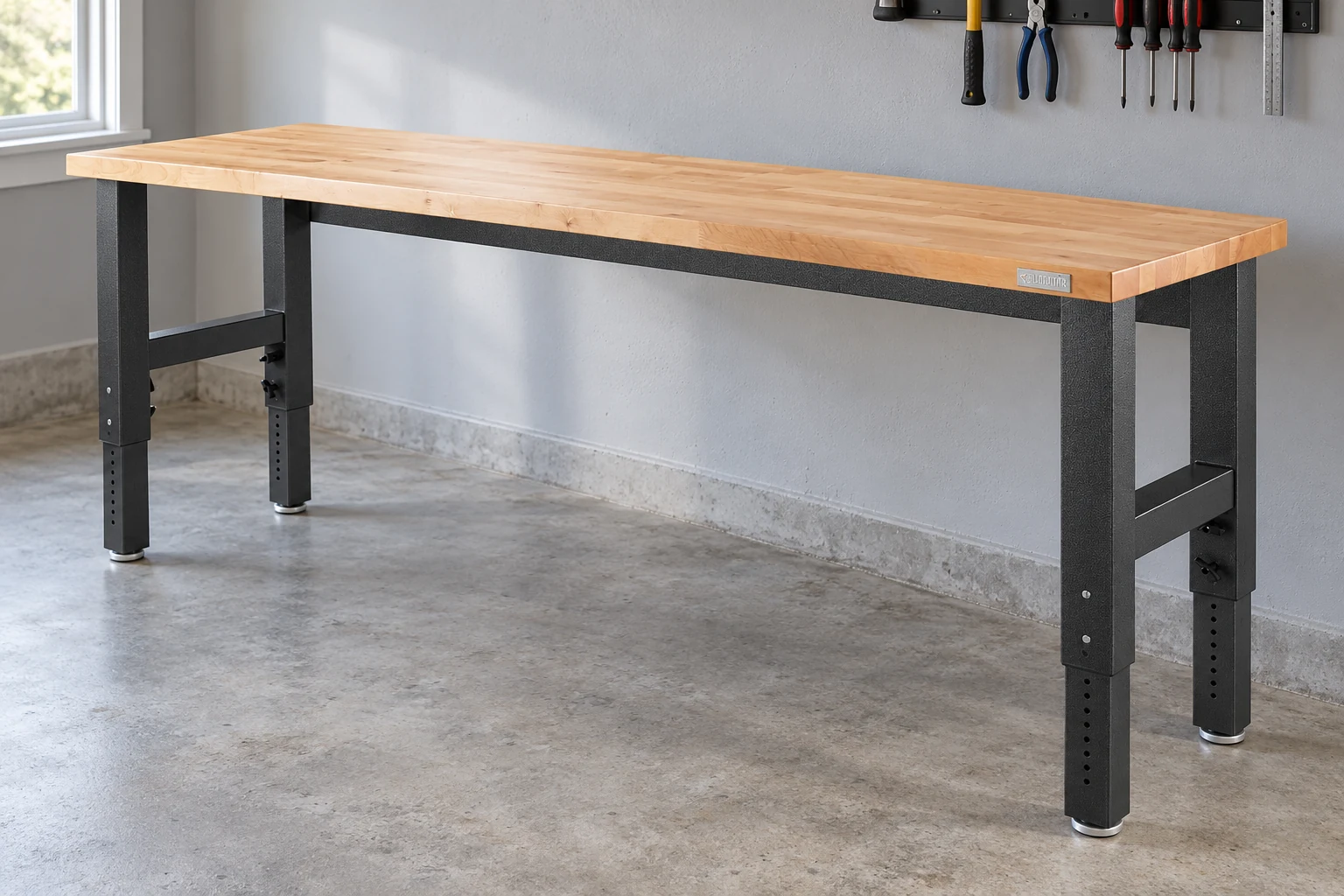
Gladiator 8-foot Adjustable Height Hardwood Workbench
Model GAWB08HWEG
Give an ongoing project a long work surface, with separate room for working and staging.Product [1]
- 96-inch width
- Solid hardwood top
- Adjustable height
Mark out 96 × 25 inches and check parking, your working position and the delivery path. If access suffers, keep your existing bench or reconsider the format.Product [1]
- A 96-inch top leaves room for long projects and staging.Product [1]
- Adjustable height lets you choose a working position within 27.5–40.8 inches.Product [1]
- UV-coated hardwood helps resist garage chemical stains.Product [1]
- Leveling legs let you adjust the bench on your garage floor.Product [4]
- The 96-by-25-inch footprint takes up a large floor area.Product [1]
- Assembly and moving require two or more people.Product [4]
- Adding casters could create a tipping hazard.Product [4]
Product specificationsShowHide
- Exact model
GAWB08HWEG.Product [1]Product [2]
- Size
96 inches wide × 25 inches deep; 27.5–40.8 inches high.Product [1]
- Construction
Solid hardwood top and welded-steel legs.Product [1]
- Published limit
3,000 pounds maximum distributed weight.Product [1] This is not a stated allowance for one concentrated load, a vise, impact work or a bench-mounted machine.
- Assembly
Required.Product [1]
- Variant qualification
The selected official model shows Hammered Granite, and Abt’s exact-model title agrees; the official description still says hammered white.Product [1]Product [2] The illustration follows the selected Hammered Granite variant reference. The shared description conflict remains unresolved; confirm the exact model and finish before ordering.
- Instructions
The official page links installation instructions W11100254 rev G.Product [1] A subsequent returned text extraction of that exact linked manual names GAWB08HWEG, specifies use in a garage and warns against a caster addition that could be a tipping hazard.Product [4] This is returned manual text, not a byte-validated full installation or site assessment.
Specification-led research, not hands-on testing. Exact installation and fit remain conditional.
Sources for the product options
- Product [1]Gladiator: Gladiator — 8-foot Adjustable Height Hardwood Workbench (GAWB08HWEG); official model, variant, dimensions and distributed-load condition
Source scope: Gladiator — 8-foot Adjustable Height Hardwood Workbench (GAWB08HWEG); official model, variant, dimensions and distributed-load condition.
- Product [2]Abt: Abt — Gladiator GAWB08HWEG in Hammered Granite; exact-model finish cross-check, not height authority
Source scope: Abt — Gladiator GAWB08HWEG in Hammered Granite; exact-model finish cross-check, not height authority.
- Product [3]WORX: WORX — Pegasus WX051; returned official product body for folding/clamps, indexed official search description for dimensions and mode-specific loads
Source scope: WORX — Pegasus WX051; returned official product body for folding/clamps, indexed official search description for dimensions and mode-specific loads.
- Product [4]Gladiator / Whirlpool: Gladiator / Whirlpool — returned exact-model assembly text, W11100254 rev G
Source scope: Gladiator / Whirlpool — returned exact-model assembly text, W11100254 rev G.
- Product [5]WORX: WORX — direct returned US product body for WX051 dimensions and distinct mode ratings; purchase entry not qualified
Source scope: WORX — direct returned US product body for WX051 dimensions and distinct mode ratings; purchase entry not qualified.
Check these items before buying
If you keep your existing setup: confirm that it fits the stored items, normal access and intended use. If it already solves the problem, stop here; the new-product and installation checks below apply only when you plan a change or purchase.
- The exact model and configuration match the documentation you reviewed.
- The footprint, open drawers, parked car, and material route fit your mock-up.
- Height, reach, and seated knee space fit the intended users.
- Load conditions and component ratings cover the intended use.
- Tool compatibility, movement rules, top care, and parts support are documented.
- The delivered and assembled cost includes everything you need.
Frequently asked questions
Should I choose the largest bench that fits?
Compare usable workspace after your equipment is on it. A smaller footprint may suit you better if it preserves access around the project and lets you park normally.
Does adjustable mean quick to change?
Not necessarily. Check the exact adjustment procedure, required tools, and unloading rules. Choose around how often you expect to change tasks or users.
Can drawers replace separate shelving?
Check your stored items against drawer dimensions and ratings first. Also check knee space and whether opening a drawer blocks the route beside the car.
Is a high capacity enough for vise work?
No. A distributed capacity figure does not establish attachment compatibility or permission for the forces involved. Get model-specific documentation for both the attachment and intended work.
Sources and evidence notes
References Guide [3] and Guide [4] were rechecked as official webpages on October 8, 2026. The manufacturer product page is not a complete assembly manual, and its distributed capacity rating does not establish compatibility with every tool or task.
- Guide [3] CCOHS: Working in a Standing Position – Basic Information
Supports matching working height to body size and task, keeping tools within easy reach, allowing position changes, and a sitting option where possible.
- Guide [4] 8' Adjustable Height Hardwood Workbench
Supports the model-specific example of a 3,000-pound maximum distributed capacity; the product page is not a complete assembly manual.