The best garage storage bin is not the largest tote or the one that matches every other container. It is the smallest practical bin that keeps one useful category together, fits the actual storage opening, protects the contents appropriately, and stays manageable when full.
Choose the contents and storage position before choosing the container. A bin that looks organized in an empty garage can become a problem when its lid hits the shelf above, its handles enter the parking aisle, or its loaded weight makes routine retrieval unsafe.
Short answer
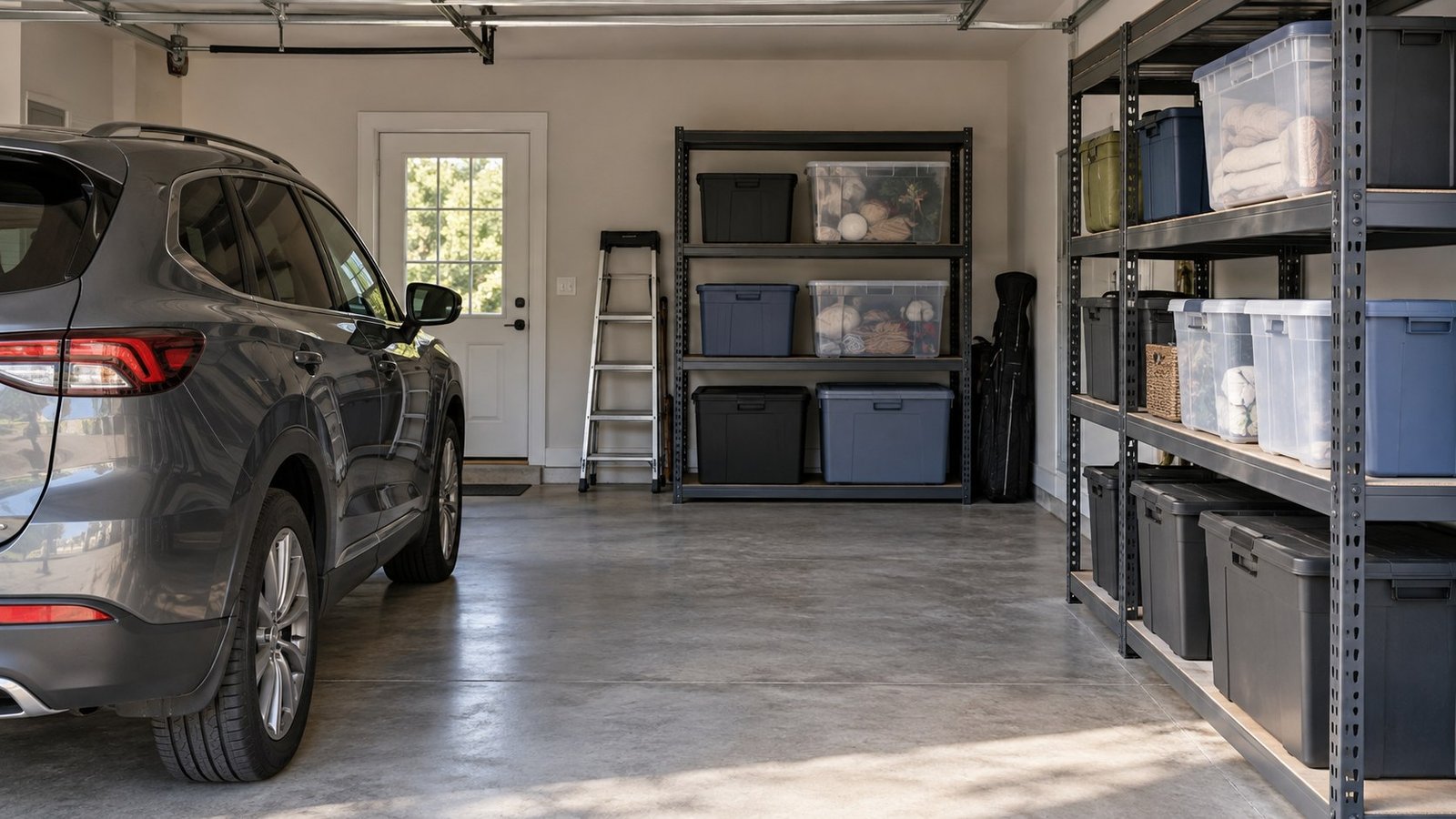
Choose the smallest bin that holds one useful category, fits the complete shelf opening with room for your hands, and remains controllable at its final loaded weight. Clear lidded bins help when visibility matters. Opaque heavy-duty totes suit bulky or impact-prone gear. Gasketed boxes may add protection from dust and incidental moisture when the exact product documents it. Open-front bins work for small items that need frequent access.
Before buying, verify the complete exterior dimensions with the lid installed, usable interior dimensions, loaded capacity, handles, latches, stacking conditions, and the protection claims for the exact model. A lidded plastic tote is not automatically waterproof, airtight, pest-proof, climate-controlled, food-safe, or appropriate for fuel and household chemicals.
Sort before buying bins
Do not begin by estimating how many matching bins will fill a wall. First reduce what needs storage. Remove trash, donations, expired materials, empty packaging, duplicates, and items that belong inside the house or at an approved disposal facility.
Then make categories that are specific enough to retrieve. “Holiday lights,” “camp cooking,” and “car-wash towels” are more useful than one bin labeled “miscellaneous.” A container should solve a repeatable storage job, not hide an unresolved pile.
If the garage still contains mixed floor clutter, use Get Things Off the Floor first. If categories do not have stable locations, map them with How to Organize a Garage into Zones before choosing container sizes.
Match the bin to the contents and access frequency
Two categories with the same volume may need different containers. Seasonal decorations can tolerate a less convenient position, while weekly sports gear needs independent access. Heavy automotive supplies belong lower than lightweight camping textiles. Small fasteners need compartments or open-front bins rather than a deep tote.
| Use pattern | Container direction | Main check |
|---|---|---|
| Daily or weekly | Small or medium bin with independent access | One-hand or two-hand retrieval without moving another bin |
| Seasonal | Lidded bin sized for one category | Protection, label visibility, and safe occasional lifting |
| Heavy supplies | Smaller reinforced bin or original container | Loaded weight, low placement, shelf rating, and handle control |
| Small parts | Divided organizer or open-front parts bin | Divider retention, label area, dust exposure, and spill control |
| Soft bulky gear | Large lightweight tote only when it remains manageable | Exterior dimensions, lid closure, and retrieval path |
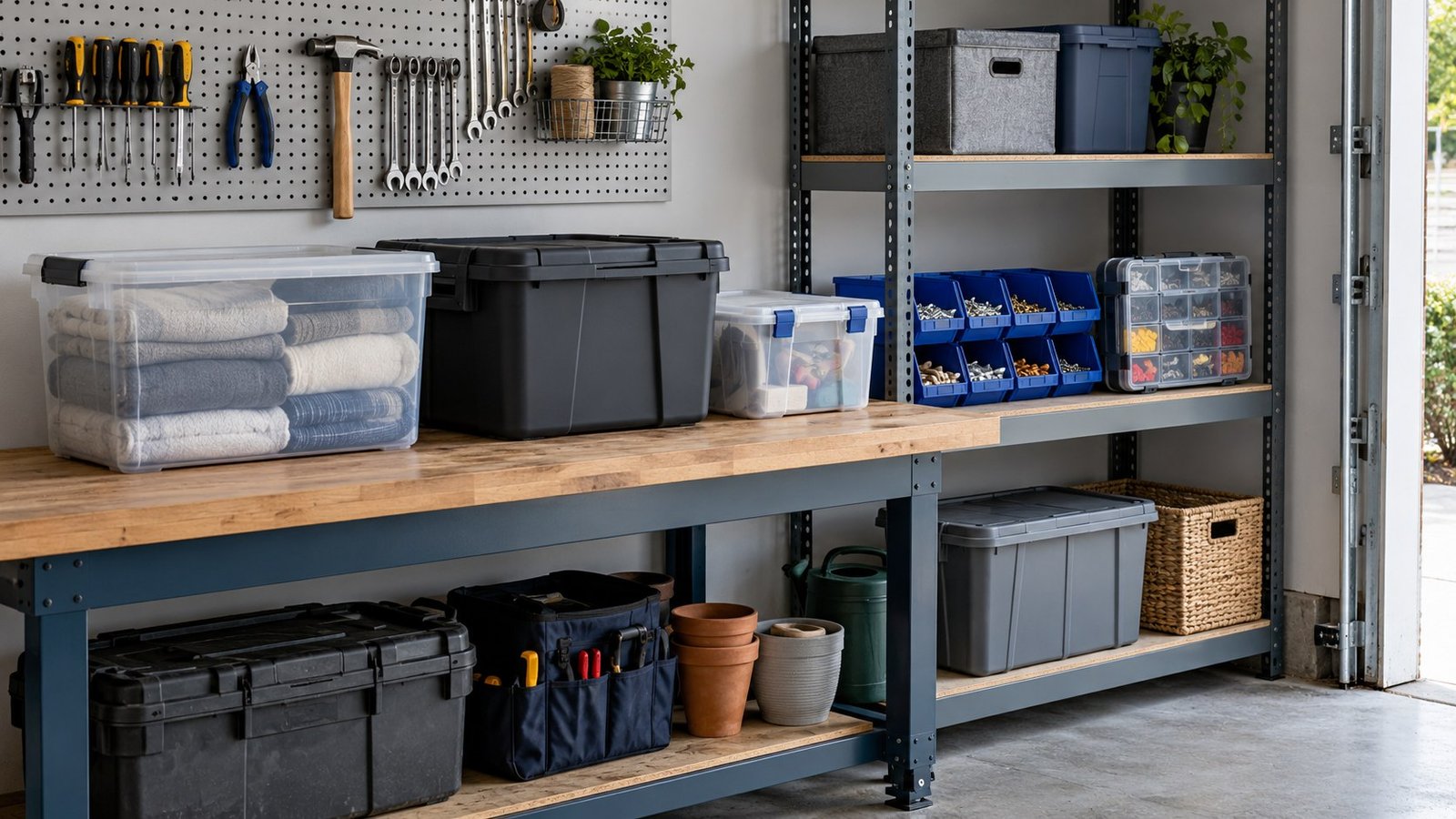
Do not assign one container style to every category. A mixed system often works better: clear bins for household overflow, opaque totes for rugged gear, small parts organizers near the workbench, and no generic bin at all for items that require original packaging or special storage.
Measure the shelf opening and the complete bin
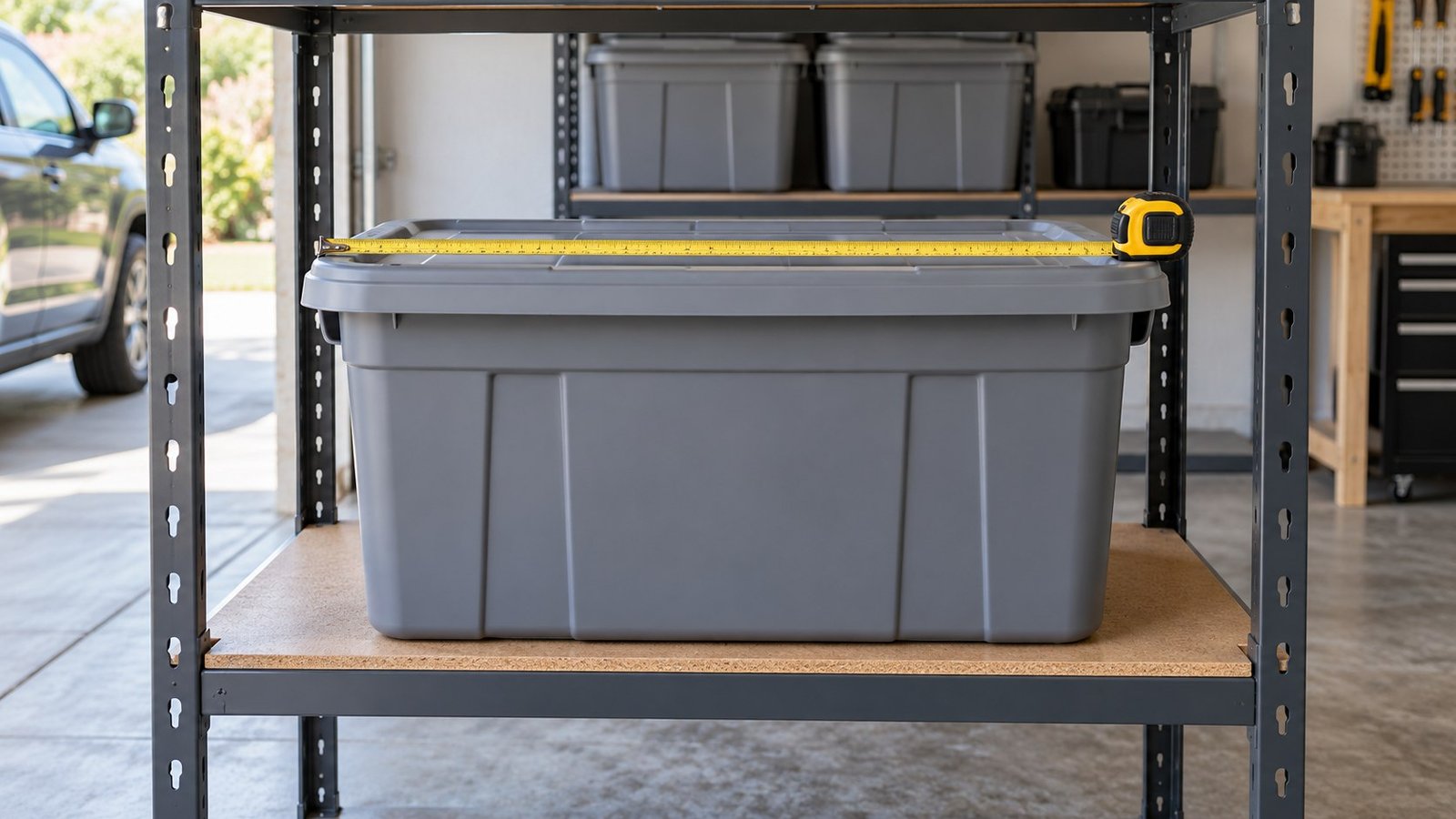
Advertised shelf width, bin capacity, and gallon count do not prove fit. Measure the clear shelf opening between uprights, beams, clips, and braces. Record usable width, depth, and height rather than the rack’s outside dimensions.
Measure the container at its widest and tallest points with the lid attached. Include the rim, lid overhang, latches, handles, wheels, hinges, and any outward taper. Exterior dimensions can be much larger than the usable floor inside a tapered tote.
Leave room to grip, tilt, slide, and carry the loaded bin. A tote that fits with no hand clearance is not operationally compatible with the shelf.
Use the shelf-fit and loading framework in Garage Shelving Buying Guide when choosing the support system at the same time as the bins.
Compare the main bin types
Clear lidded totes
Clear sides make it easier to confirm contents without opening the bin. They work well for mixed household storage and categories whose labels may become outdated. The tradeoff is visible clutter and product-specific durability. Light-sensitive contents may need an opaque container or another location.
Opaque heavy-duty totes
Opaque totes are common for bulky garage gear, transport, and impact-prone use. A recessed lid may support stacking, but only under the conditions stated for the exact model. Large heavy-duty bins are easy to overfill, so the user should evaluate loaded weight before choosing a large capacity.
Gasketed latching boxes
A gasket and latches can improve closure against dust and incidental moisture when the manufacturer documents those features. That does not automatically make the box waterproof, submersible, climate-controlled, or appropriate for every material. Confirm the exact closure and environmental claims.
Open-front bins
Open-front bins keep fasteners, fittings, consumables, and small tools visible and independently accessible. They offer little protection from dust, moisture, spills, children, or pets. Confirm shelf or rail compatibility and keep the load inside the bin’s documented limit.
Small divided organizers
Divided organizers work for screws, anchors, electrical parts, craft supplies, and other small items. Check whether dividers stay seated when the case is moved, whether the lid prevents parts from crossing compartments, and whether the latch and handle are suitable for the loaded contents.
Choose capacity by loaded weight, not gallon count alone
Gallon capacity describes volume, not how safely a person can lift the container or how much load the tote and shelf can carry. Books, hardware, liquids, automotive supplies, and dense tools can make a small bin heavier than a large tote filled with textiles.
Load a test box with the intended category and weigh it when practical. The regular user should be able to grip, move, and control the container from its final shelf height. If the test load is awkward, divide the category into smaller bins or keep it at floor level on an appropriate support.
Verify the exact bin’s weight capacity and the shelf’s per-level and total limits. Do not combine ratings from similar-looking models or assume that a stackable lid is rated to carry any loaded tote placed above it.
Check lids, latches, handles, and stacking
A lid must remain attached during normal handling, but closure styles solve different problems. Snap lids are simple. Latches can make repeated opening easier. Gaskets may add environmental protection. Lock holes may deter casual access, but they do not prove child resistance or theft protection.
Handles should provide enough room for the user’s fingers at the loaded weight. Test whether handles flex, pinch, or disappear under the lid. A wheeled tote may reduce carrying, but its wheels and pull handle add exterior dimensions and require a clear rolling route.
Stack only as the exact product permits. Stable stacking depends on matched lids and bases, a level surface, load distribution, container condition, and any published stack limit. Even a stable stack can be a poor daily system when lower bins cannot be reached without unloading the top.
Plan for dust, incidental moisture, pests, and temperature
Start with the garage environment and the sensitivity of the contents. A lid helps with falling dust, but an ordinary tote may still exchange air or admit moisture around the rim. “Water resistant” is not the same as “waterproof.” A gasketed closure does not create temperature or humidity control.
Inspect the garage for leaks, condensation, floor water, pest activity, and direct sun before relying on containers. Keep bins off a floor that becomes wet, correct the building problem where possible, and follow the stored item’s environmental guidance. Sensitive documents, photographs, electronics, medications, food, and temperature-sensitive finishes may require indoor conditioned storage.
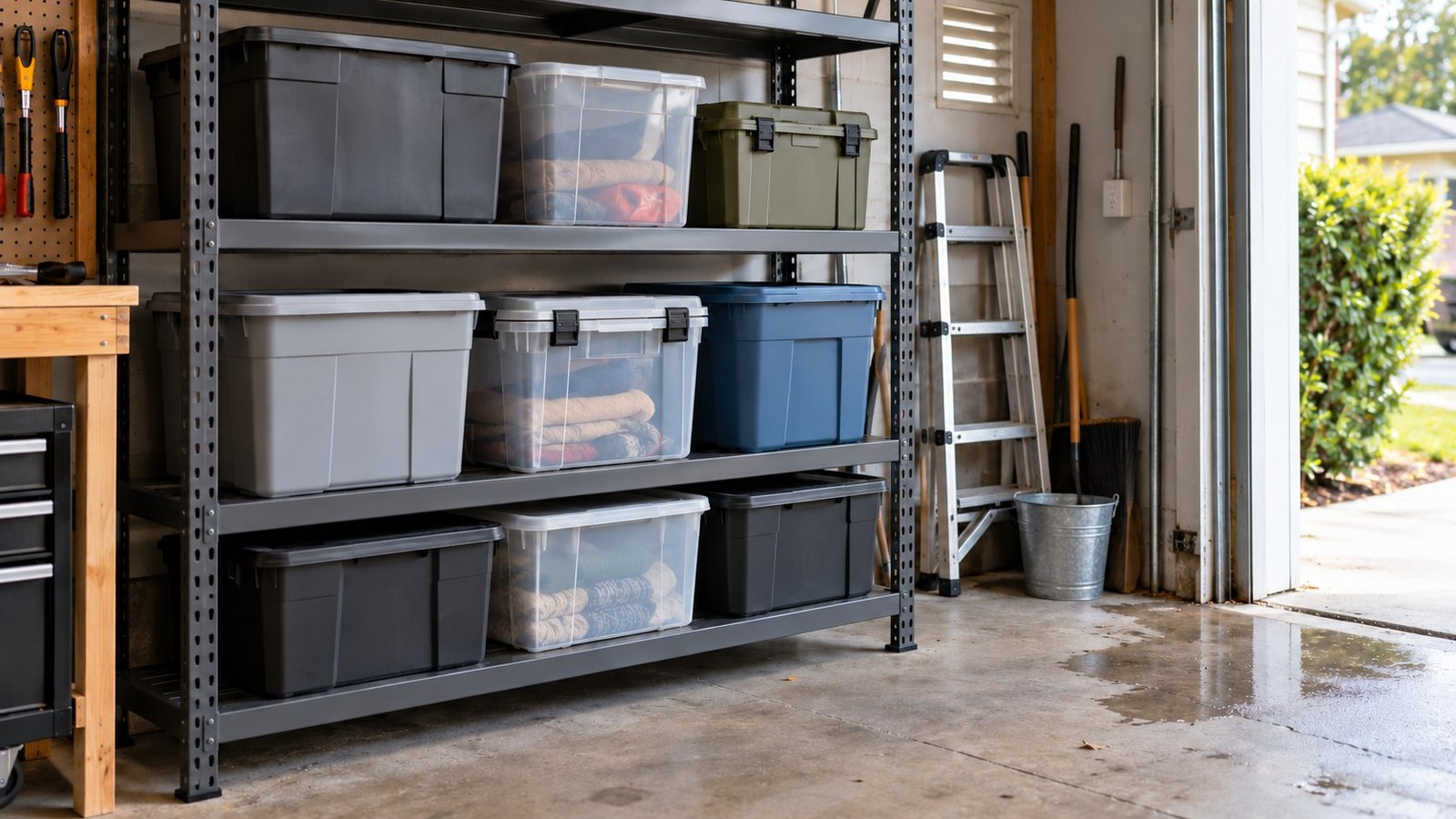
A closed tote should not be used to conceal an active moisture, mold, or pest problem. Clean and dry the contents first, and do not seal damp textiles, sports equipment, or garden gear in a way that traps moisture.
Build a repeatable bin system
A repeatable system does not require every container to be identical. It requires a limited set of sizes with known shelf positions, lids that stay paired, labels in consistent locations, and enough future availability to replace a damaged bin.
- Choose the shelf opening and category groups first.
- Test one sample bin with the lid, handles, and intended contents.
- Confirm hand clearance and retrieval with the vehicle parked.
- Use a small number of compatible footprints rather than many unrelated shapes.
- Reserve unused capacity instead of filling every inch on day one.
- Keep a record of the exact bin family and size only if future matching matters.
Buying one sample before a large set is usually more useful than relying on a nominal gallon size. It reveals how the taper, rim, lid, and handles interact with the actual shelf.
Label and inventory the system
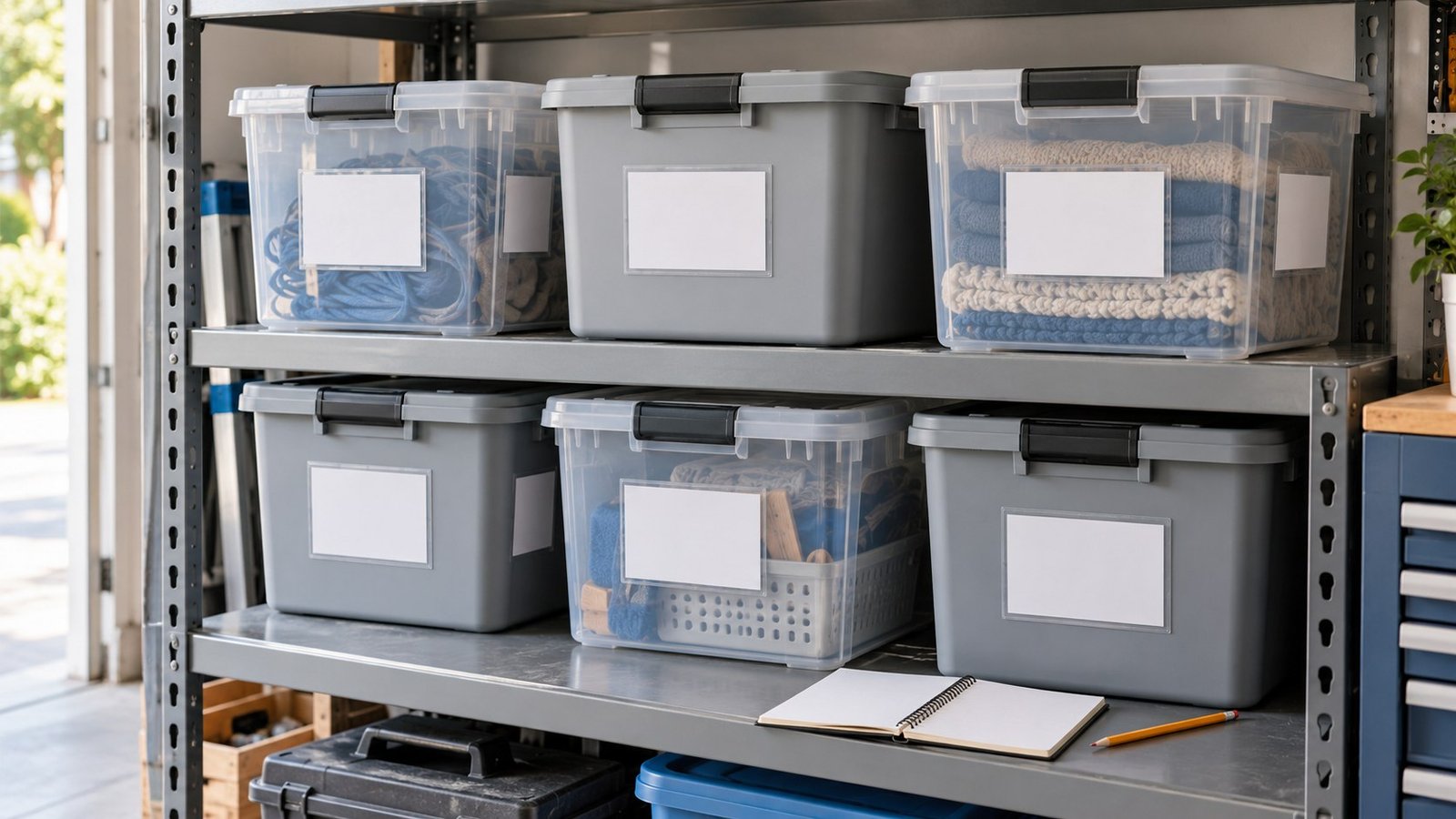
Use a large category label that can be read from the aisle. Label at least two visible sides when a bin may change orientation. A removable label or label pocket makes the system easier to update than writing directly on every tote.
For many seasonal bins, give each container a short ID and keep a simple inventory. The label should remain useful when the contents change. Avoid recording sensitive information on a bin visible from outside the garage.
Review categories once or twice a year. If a bin repeatedly accumulates unrelated items, the category is too broad, the storage position is inconvenient, or the household needs a defined return routine.
Place bins by frequency and weight
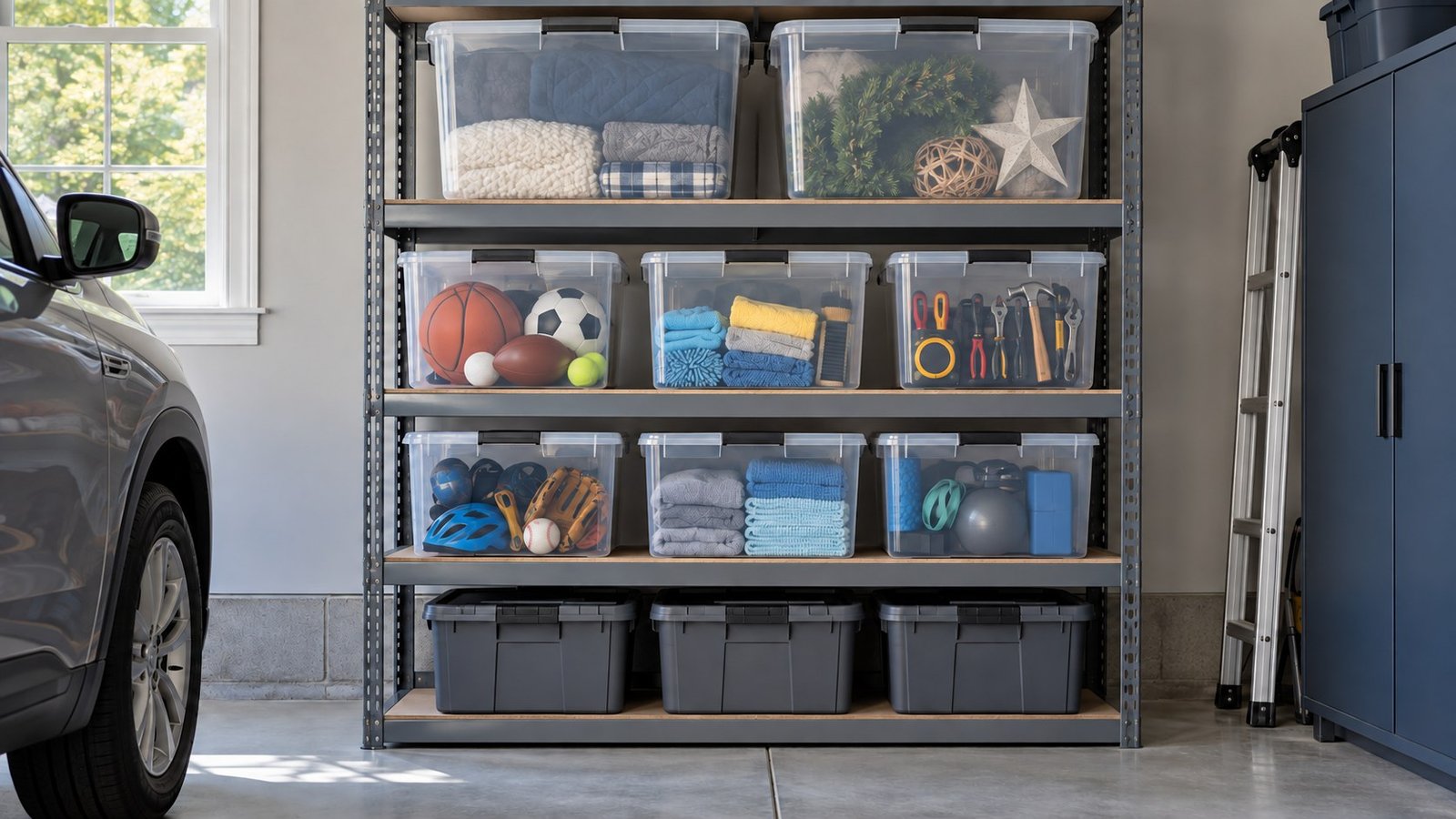
Keep frequently used categories between comfortable knee and shoulder reach when their size and weight allow. Put heavy and awkward bins low. Reserve upper shelves for light, infrequently used items that can be retrieved without an unsafe reach or improvised climbing setup.
Protect the vehicle, house door, walking path, electrical panel, appliances, utilities, and garage-door movement. If the bin zone shares a bay with a parked vehicle, apply the protected-envelope method in Half Parking, Half Storage.
Do not place a large bin overhead simply because it is lightweight when empty. The loaded weight, lid retention, access method, overhead structure, and consequence of a dropped container all matter. Review Ceiling Storage before considering bins above a vehicle or walking area.
Keep hazardous and sensitive items out of generic bins
A general-purpose tote is not a substitute for an approved fuel container, flammable-storage cabinet, original chemical package, battery enclosure, or conditioned archive box.
- Keep household hazardous products in their original labeled containers and follow the label.
- Never mix leftover chemicals or move them into food or drink containers.
- Use only appropriate fuel containers and follow current storage, ventilation, child-safety, and ignition-separation guidance.
- Do not hide leaking, corroded, swollen, damaged, recalled, or unidentified products inside another bin.
- Use local household-hazardous-waste guidance when a product needs disposal.
- Store sensitive documents, photographs, electronics, medications, food, and other climate-sensitive items according to their actual environmental requirements.
The U.S. Environmental Protection Agency advises keeping hazardous products in original containers, retaining labels, and never mixing leftovers. The U.S. Consumer Product Safety Commission warns against using inappropriate containers for gasoline and other liquid fuels. The U.S. Fire Administration identifies flammable liquids, combustibles, and charging equipment as important garage fire risks.
Final buying checklist
| Decision | Record before purchase |
|---|---|
| Contents | One useful category, sensitivity, use frequency, and final loaded weight |
| Bin fit | Complete exterior width, depth, height, rim, lid, handles, latches, wheels, and taper |
| Shelf fit | Clear opening, hand space, removal movement, shelf rating, and final position |
| Protection | Exact dust, moisture, gasket, temperature, food, pest, or security claims needed |
| Handling | User reach, grip, lift, carry, rolling route, and independent access |
| System | Label position, repeatable footprints, replacement availability, and future capacity |
Pause the purchase if the listing gives only gallon capacity, if the complete dimensions with the lid are unclear, if the protection claim is ambiguous, if the loaded bin would be difficult to control, or if routine access requires dismantling a tall stack.
Common questions
Are clear or opaque storage bins better for a garage?
Clear bins make contents easier to identify, while opaque bins hide visual clutter and may suit rugged bulk storage. Choose by contents, access, durability, and light sensitivity rather than appearance alone.
What size storage bin works best on garage shelves?
There is no universal size. Measure the shelf’s clear width, depth, and height, then compare the bin’s complete exterior dimensions with the lid installed. Leave space for hands and removal, and check the loaded weight.
Are plastic storage totes waterproof?
Not automatically. Many products are described only as water resistant. Confirm the exact manufacturer’s claim and closure instructions. A gasket or lid does not create climate control or guarantee protection from leaks, flooding, or condensation.
Should garage storage bins be stacked?
Only under the exact product’s stacking conditions and when the stack remains stable and usable. Routine-access bins should not require unloading several containers. Keep heavy bins low and inspect lids and bases for damage.
How heavy should a garage storage bin be?
Light enough for the regular user to control from its final position and within the exact bin and shelf ratings. Dense categories often need several smaller bins even when one large tote has enough volume.
Can gasoline, paint, pesticides, or chemicals go inside a plastic tote?
Do not use a generic tote as the primary container or assume it makes hazardous storage safe. Keep products in their original labeled containers, follow each label, use approved fuel containers where applicable, separate incompatible materials, and follow local household-hazardous-waste guidance.
Sources reviewed
- The Home Depot, Garage Storage Buying Guide
- Lowe’s, Garage Storage Buying Guide
- The Home Depot, HDX 27 Gal. Tough Storage Tote, model 999-27G-HDX
- IRIS USA, WeatherPro 74 QT Gasket Box
- Sterilite, 18 Gal. Latching Tuff1 Tote
- U.S. Environmental Protection Agency, Household Hazardous Waste
- U.S. Consumer Product Safety Commission, Fuel Container and Liquid Fuel Safety
- U.S. Fire Administration, Basement and Garage Fire Safety